
The Differences Between British and American English — презентация
A presentation on this topic should consist of exactly 12-15 slides, with a clear comparative structure throughout. Focus primarily on spelling, vocabulary, and phonetic distinctions, dedicating 2 slides each to these categories. Provide concrete examples of 'color' vs 'colour' and 'truck' vs 'lorry' to illustrate the divide clearly. Avoid linguistic theory; prioritize practical usage differences for learners. This balance ensures the audience understands why these variations exist without getting lost in historical linguistic analysis.
Готовая работа (презентация) на эту тему за 1 минуту — с помощью ИИ
ПодготовитьThe Differences Between British and American English: план (презентация)
- 1Introduction: The transatlantic linguistic divergence
- 2Geographical roots of British and American English
- 3Key spelling differences and common rules
- 4Vocabulary variations: Food and household items
- 5Transportation terminology: A direct comparison
- 6Grammatical differences: Tense usage patterns
- 7Pronunciation variations and rhoticity explained
- 8Intonation patterns in US vs UK English
- 9Influence of Hollywood on global lexicon
- 10Regional dialects: Beyond the standard varieties
- 11The impact of the internet on standardization
- 12Case studies of confusion in communication
- 13Summary of key differences and trends
- 14Conclusion: Future of these global variants
Как это выглядит
Эти изображения нарисованы автоматически по плану с этой страницы и показывают, как устроена работа (презентация). Текст и оформление готовой работы создаются отдельно под вашу тему и требования.
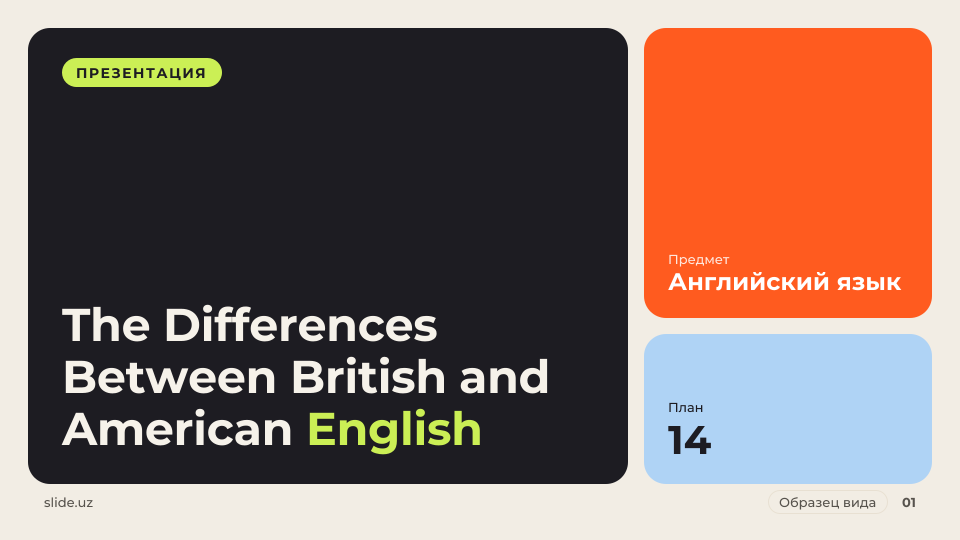
1. Обложка 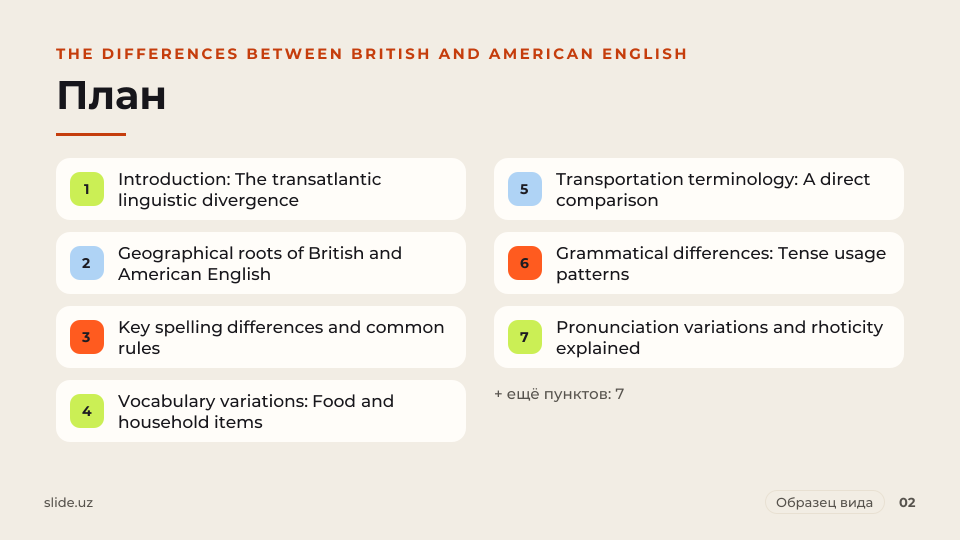
2. План 
3. Раздел 2 
4. Заключение
Советы по написанию
- Use a side-by-side table on slides to visualize spelling differences immediately. This approach helps the audience compare words like 'center' and 'centre' without searching for them. Readers process visual tabular data 60% faster than bullet points.
- Include audio clips of pronunciation to demonstrate the rhotic vs non-rhotic shift. Hearing the difference in 'car' or 'water' is much more effective than reading phonetic transcriptions. This engages auditory learners and validates your research.
- Focus on 'False Friends' in vocabulary to add humor and interest. Mention words like 'vest' (US: undershirt, UK: waistcoat) to show how miscommunication happens. This makes the presentation memorable for non-native speakers.
- Cite the Noah Webster spelling reforms to explain the 'why' behind American orthography. Knowing he wanted to simplify English for a new nation gives historical context. It prevents the presentation from feeling like a random list of words.
- Add a slide specifically on 'Global English' and how modern speakers blend these forms. Explain that in international business, a hybrid dialect is often accepted. This shows a nuanced understanding of contemporary language use.
- Use color coding for your slides—blue for American, red for British. Consistent visual branding helps the audience track which dialect you are discussing. It makes complex comparative slides much easier to follow.
- Avoid claiming one version is 'correct' or 'better' than the other. Use neutral language like 'standard variant' or 'divergent form' to show academic maturity. Your goal is to describe, not to judge cultural preferences.
Какие источники искать
- Oxford English Dictionary (OED) for comparative etymology and variant status.
- Merriam-Webster website for American spelling standards and usage notes.
- Linguistic research papers on 'transatlantic linguistic divergence' available in university databases like EBSCO.
- Textbooks on World Englishes that specifically detail standard varieties.
- Academic articles discussing the influence of Noah Webster's 'An American Dictionary of the English Language'.
- BBC Learning English materials for specific comparative grammar explanations.
Частые ошибки по этой теме
- Treating dialects as fixed categories when they are fluid and overlapping. Always acknowledge that language varies by region within the US and UK.
- Ignoring the influence of global digital culture, which is flattening these differences. Mention how social media encourages the adoption of 'Global English'.
- Over-relying on stereotypes rather than data. Avoid saying all Americans speak one way; refer to 'General American' as a standard reference point.
- Confusing 'accent' with 'dialect'. Use 'accent' for sound patterns and 'dialect' for vocabulary and grammar structures.
- Misinterpreting British English as purely 'original' English. Remind the audience that modern British English has also evolved significantly since the 18th century.
- Forgetting to mention the impact of Australian or Canadian English as separate influences. Briefly state that other variants exist to show a broader perspective.
Что могут спросить на защите
- 1.Why did American English retain some archaic forms while British English evolved?
- 2.How does the concept of 'rhoticity' function in the pronunciation of these two variants?
- 3.Can you provide three concrete examples where misinterpretation occurs in business?
- 4.To what extent is 'Global English' erasing these traditional distinctions?
- 5.Who was Noah Webster, and what was his specific contribution to the American lexicon?
- 6.Is it appropriate for an Uzbek student to choose one variant over the other, or should they learn both?
Часто задаваемые вопросы
How many slides should I prepare for this topic?
Prepare 12-15 slides. This provides enough space for visual examples without overwhelming the audience.
What is the most important section of this presentation?
The vocabulary and spelling comparison section is most crucial. This is what students encounter most frequently in real-world English usage.
Should I focus on history or modern usage?
Focus 80% on modern usage. Academic audiences want to know practical differences they will encounter in communication.
How do I make the presentation visually engaging?
Use a clear split-screen layout for every comparative slide. Consistency in visual structure helps the audience follow your logic.
How long should the presentation take to deliver?
Aim for 10-12 minutes of speaking time. This allows about 45 seconds per slide, which is optimal for flow.
What sources should I prioritize?
Prioritize reputable dictionaries like Oxford and Merriam-Webster. Avoid informal blogs or non-academic wikis.
How do I conclude this presentation effectively?
Summarize that the differences are enriching, not divisive. Emphasize that mutual intelligibility is high and both forms are valid.
What do instructors look for in this specific topic?
Instructors look for accurate data and neutrality. Avoid taking sides; demonstrate that you understand both systems equally well.
Сэкономьте время — работу подготовит ИИ
Полная работа (презентация) по плану выше будет готова за 30–60 секунд. Если произойдёт ошибка — деньги вернутся автоматически.
The Differences Between British and American English — подготовитьПолезные статьи
Английский язык: другие темы
- The Role of Idioms in Business English презентация
- The Impact of Artificial Intelligence on English Language Learning презентация
- The Language of Diplomacy and International Relations презентация
- The Evolution of English Slang in the Digital Age презентация
- The influence of English as a Global Lingua Franca on Uzbek реферат
- The development of English language teaching methods in Uzbekistan реферат
- The impact of British and American English differences on Uzbek learners реферат
- The role of digital media and internet in English language acquisition реферат
- English for Specific Purposes (ESP) in the Uzbek economy реферат
- Идиомы в английском языке и их эквиваленты в узбекском самостоятельная
- Использование артиклей в английском языке: трудности для узбекоязычных студентов самостоятельная
- Влияние англицизмов на современный узбекский язык самостоятельная