
The Language of Diplomacy and International Relations — презентация
A presentation on the language of diplomacy requires a structured 14-slide format, balancing historical protocol with modern communication strategies. Dedicate the first 3 slides to defining 'diplomatic register' and its formal, cautious nature. Follow with 8 slides analyzing specific lexical choices, euphemisms, and the nuance of 'ambiguity' in negotiations. The final 3 slides must discuss how this specialized English facilitates conflict resolution and global stability. This structure moves from definitions to practical analysis, maintaining a high academic tone throughout.
Готовая работа (презентация) на эту тему за 1 минуту — с помощью ИИ
ПодготовитьThe Language of Diplomacy and International Relations: план (презентация)
- 1Introduction: Diplomacy as a distinct language field
- 2Defining the Diplomatic Register: Formal and neutral
- 3Key terminology: Protocol, sovereignty, and statecraft
- 4The art of the Euphemism: Saying no politely
- 5Ambiguity: A deliberate strategic tool
- 6The role of politeness markers in negotiations
- 7Non-verbal communication in diplomatic settings
- 8Written diplomacy: The structure of official notes
- 9Differences: Traditional vs modern digital diplomacy
- 10Case study: A famous treaty negotiation analysis
- 11Language as a barrier vs bridge to peace
- 12The role of English as the global diplomatic lingua franca
- 13Challenges of cross-cultural diplomatic communication
- 14Conclusion: The power of words in statecraft
Как это выглядит
Эти изображения нарисованы автоматически по плану с этой страницы и показывают, как устроена работа (презентация). Текст и оформление готовой работы создаются отдельно под вашу тему и требования.
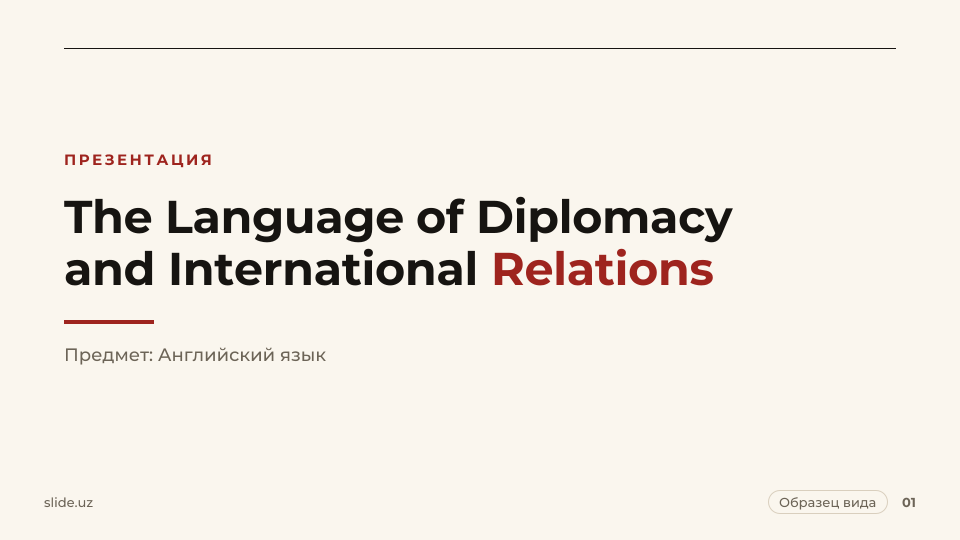
1. Обложка 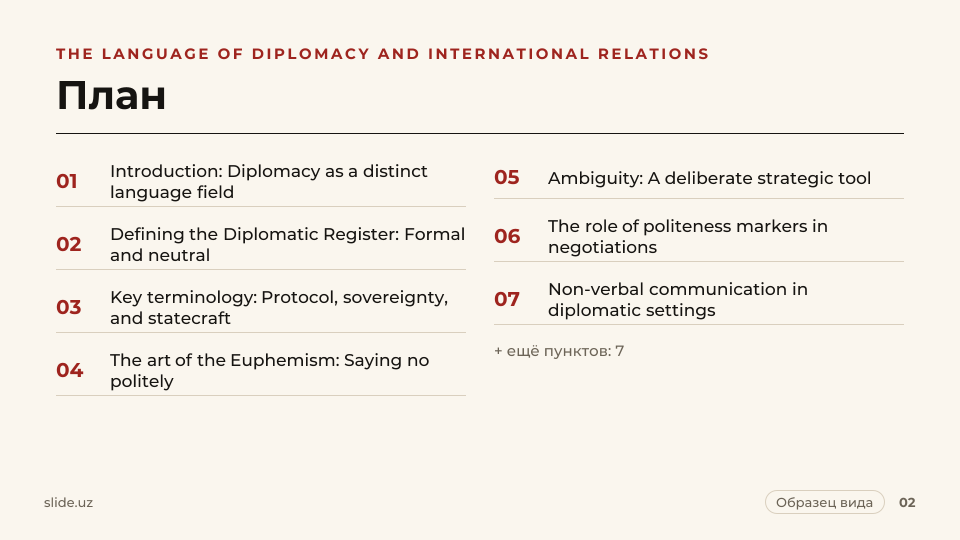
2. План 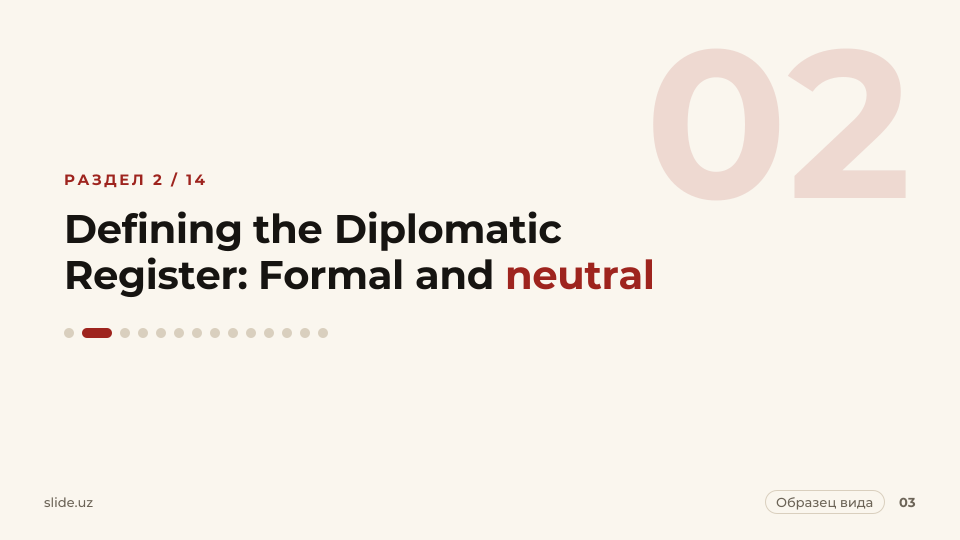
3. Раздел 2 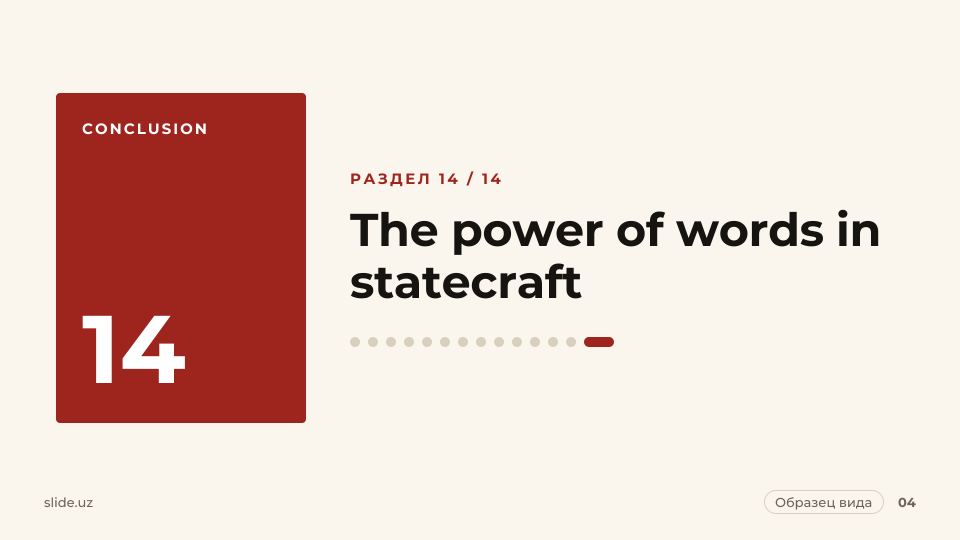
4. Заключение
Советы по написанию
- Explain the concept of 'strategic ambiguity'. Give examples of phrases like 'the parties will work towards...' which allow flexibility without committing to hard deadlines. This is the core skill in diplomacy.
- Use real examples of official diplomatic cables or communiqués. Redact them if necessary, but keep the formal tone to show the audience what 'official language' actually looks like.
- Create a table comparing 'Direct/Casual' vs 'Diplomatic/Formal' language. Show how an angry demand is transformed into a diplomatic request. This technique clearly illustrates the linguistic shift.
- Mention the 'Vienna Convention on Diplomatic Relations'. Referencing legal frameworks gives your presentation a solid foundation of authority. It shows you have done serious research.
- Focus on the power of 'modal verbs' (should, may, might) in diplomatic texts. Explain how shifting from 'will' to 'should' completely changes the nature of an agreement. It is a subtle but vital linguistic nuance.
- Use a professional, calm design theme. Avoid bright, flashy colors; use muted, serious tones like navy blue or slate gray. The visual style should mirror the subject matter.
- Discuss the challenges of 'Translation vs. Interpretation'. Mention that diplomatic English is often interpreted, and explain why precision in vocabulary is a matter of national security.
Какие источники искать
- United Nations (UN) public records and official statements.
- Academic textbooks on 'Diplomatic Discourse' or 'Political Linguistics'.
- Archives of official treaties (e.g., Treaty of Versailles, Kyoto Protocol).
- Books by former diplomats focusing on negotiations and language.
- Journals dedicated to International Relations and Security Studies.
- Style guides from the US State Department or the British Foreign Office.
Частые ошибки по этой теме
- Confusing 'diplomacy' with general 'politeness'. Clarify that diplomatic language is formal and strategic, not just 'nice' or 'kind'.
- Overusing historical anecdotes instead of linguistic analysis. Keep the focus on how the language actually functions.
- Ignoring the impact of English hegemony. Address why English became the default language of diplomacy even when parties are not native speakers.
- Being too simplistic with 'euphemisms'. Do not just call it 'lying'; call it 're-framing' or 'de-escalation' to be precise.
- Failing to mention the role of protocol. Remember that in diplomacy, how you say it (the medium/form) matters as much as what you say.
- Assuming all diplomatic language is clear. Emphasize that sometimes, clarity is avoided intentionally to facilitate agreement.
Что могут спросить на защите
- 1.Why is ambiguity a strategic asset in international negotiations?
- 2.How does the diplomatic register differ from standard business English?
- 3.What is the role of modal verbs in ensuring 'deniability' in diplomatic documents?
- 4.How has the internet changed the language of traditional diplomacy?
- 5.Is there a universal 'diplomatic style' in English, or does it vary by country?
- 6.How does a diplomat maintain neutrality while using English as a primary tool?
Часто задаваемые вопросы
How many slides should I prepare for this complex topic?
Prepare 14 slides. This provides enough depth to explore both the theoretical and practical sides.
What is the most critical element of the presentation?
The section on 'strategic ambiguity' and 'euphemisms'. That is the heart of what makes diplomatic language unique.
How should I handle the history of diplomacy?
Keep history as a brief context. Focus 90% of your time on the linguistic mechanics of the language.
Should I provide examples from real conflicts?
Yes, but choose neutral or well-documented historical examples. Avoid current, highly sensitive geopolitical topics to keep the academic focus.
How do I make the presentation engaging?
Use the 'before and after' translation technique. Show a blunt phrase and then rephrase it in diplomatic English.
What sources are most valued by instructors?
Primary documents from international bodies like the UN or major historical treaties are the most highly valued.
How to structure the conclusion?
Summarize that language is a tool for peace, capable of de-escalating tensions through precision and careful phrasing.
Is visual design important for this topic?
Yes, it must be professional and austere. Avoid animations; use a clean, formal layout.
Сэкономьте время — работу подготовит ИИ
Полная работа (презентация) по плану выше будет готова за 30–60 секунд. Если произойдёт ошибка — деньги вернутся автоматически.
The Language of Diplomacy and International Relations — подготовитьПолезные статьи
Английский язык: другие темы
- The Evolution of English Slang in the Digital Age презентация
- The influence of English as a Global Lingua Franca on Uzbek реферат
- The development of English language teaching methods in Uzbekistan реферат
- The impact of British and American English differences on Uzbek learners реферат
- The role of digital media and internet in English language acquisition реферат
- English for Specific Purposes (ESP) in the Uzbek economy реферат
- Идиомы в английском языке и их эквиваленты в узбекском самостоятельная
- Использование артиклей в английском языке: трудности для узбекоязычных студентов самостоятельная
- Влияние англицизмов на современный узбекский язык самостоятельная
- Особенности официально-делового стиля в английском языке самостоятельная
- Методика использования подкастов для совершенствования аудирования самостоятельная
- The History of the English Language презентация